Art gallery catalog template for editions, prints and ceramics
An art-directed gallery catalog with real photography and minimal type, made for galleries, print studios and artists who sell editions, ceramics and paintings and need pages for certificates, framing and openings.
Free plan available — all templates are included on every plan. Already have an account? Open it in Templates.


All 27 pages: 7 covers and 20 designed pages
Choose one cover and any of the designed pages — they share one look, so the catalog stays consistent however many you use. Every word, color and photo is editable.










Product pages that fill themselves
Import your products and they take this layout automatically — shown here with sample products. Switch the grid any time, from 2 × 2 to 4 × 5 or a one-column line sheet.


About the Art & Gallery template
This art gallery catalog template is minimal in the gallery sense: plenty of white wall and one strong image at a time. Inter is used at every size, from a huge issue number in ultramarine to numbered sections like (01), with figure captions in a mono face. Small geometric markers punctuate the pages: a blue circle, a yellow square, a half circle, a triangle. Seven cover designs and 20 designed pages follow the logic of wall labels and exhibition guides, and the product pages are designed too, with mosaic layouts.
Galleries, print studios and artists use it to show work with the details collectors expect: medium, size, year, edition, price and whether a piece has sold. Pages on reserving, framing, certificates and care answer questions before the first email, and the opening invitation and open-studio promo bring people in. Add works from Shopify or a CSV file, share the catalog as a flipbook, or send your printer a CMYK PDF with bleed and crop marks.
Best for
- Galleries publishing a seasonal catalog of the artists they represent
- Print studios selling signed, numbered limited editions
- Ceramic artists and object makers with a collector audience
- Artists preparing an exhibition catalog or open-studio price list
- Art fairs and pop-up shows that need a printed list of works
Pages worth a closer look
Artwork page with a full wall label
One work fills the page with artist, birth year and city, year, medium, size, edition and artist's proofs, signature, price and how many of the edition have sold. A short text explains the work, much as a good wall label would.
Formats and framing guide
Print formats are drawn to scale from A4 to 70 × 100 cm with edition sizes and starting prices, alongside three in-house frame finishes with their surcharges and glazing. It turns a familiar pre-sale email exchange into a single page.
Collector questions, answered
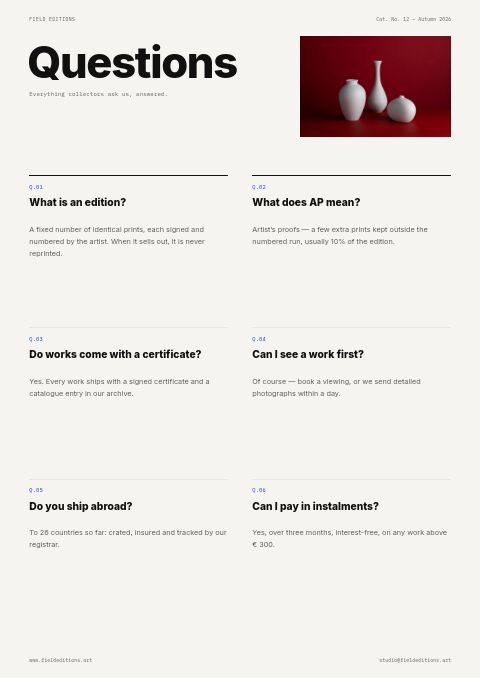
Plain answers to what collectors ask most: what an edition is, what AP means, whether works come with a certificate and how they ship. It is especially helpful for people buying their first limited-edition print.
How to collect in four steps
Choose from the catalog or the gallery, reserve a work for 48 hours by email, pick a frame, then collect it or receive it insured with a certificate. Installment terms sit in a band below the steps, so cost is never a guess.
What collectors expect from an art gallery catalog
Write every caption like a wall label
Artist, title, year, medium, dimensions (height before width), edition and price, in the same order on every page. Collectors scan captions before they read essays, and consistent labels make a catalog feel curated rather than assembled.
Explain editions and proofs
For prints, state the edition size, how many artist's proofs exist, the printing method and paper, and whether each print is signed and numbered. Note when an edition is nearly sold out; it is useful information for collectors, not pressure.
Show works at a scale buyers can judge
Include installation views or works photographed on a wall, so buyers can judge size against a room. A formats page that draws editions to scale does the same job for prints sold in several sizes.
Be clear about framing, shipping and payment
Collectors ask whether a work is framed, how it ships and whether it can be paid in installments. Put framing options with prices, insured shipping, payment terms and how long you hold a reserved work on one page.
Time the catalog to your program
Publish a catalog for each season or exhibition and have it ready a week before the opening, so it can go out with the invitations. A flipbook link in the invitation email lets guests preview works and email a reservation before the crowd arrives.
From product list to finished catalog
Pick this template
Open Art & Gallery in EasyCatalog and choose the cover and the pages you want — every page is optional and editable.
Add your products
Import from Shopify in one click, or upload a CSV, connect WooCommerce or a product feed. Your products fill the product pages automatically.
Download or share
Export a print-ready PDF (up to 300 DPI, CMYK and bleed for print shops) or share an online flipbook with a built-in order form.
Questions about this template
Which pages are included in the Art & Gallery design kit?
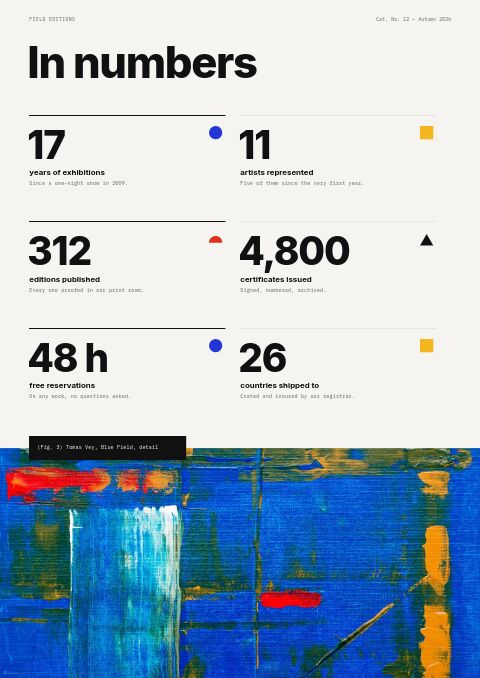
Seven covers, among them a framed now-showing cover, an open-studio poster and a gallery magazine, and 20 designed pages: welcome note, contents, section divider, installation views, featured work, gallery story, team, how to collect, most collected, open-studio promo, numbers, opening invitation, press and collector quotes, collector FAQ, formats and framing, care, visit, terms, notes and back cover. Designed product pages and mosaics are included.
Can collectors buy works directly from the online catalog?
If your works are in a Shopify store, share a retail flipbook and collectors check out at your store. Galleries that prefer reservations by email can share a showcase flipbook and keep the steps from the how-to-collect page. Each link comes with a QR code for wall labels and invitations.
What should an exhibition catalog include?
A short introduction to the show or artist, a list of works with full captions and prices, installation or studio photographs, artist biographies and the practical details: dates, opening hours, address, how to reserve or buy and the terms of sale. Many galleries add an essay or interview for context.
Should an art catalog show prices?
For a selling exhibition or an edition catalog, printed prices reduce hesitation and save gallery staff time, while some galleries keep a separate price list for high-value works. In EasyCatalog the price is one of the product fields, so you can show it on each work or leave it off.


Start your Art & Gallery catalog
Pick this template, add your products and download a print-ready PDF or share an online flipbook. Free plan available, no card needed.