A wholesale price sheet template that shows how long prices hold
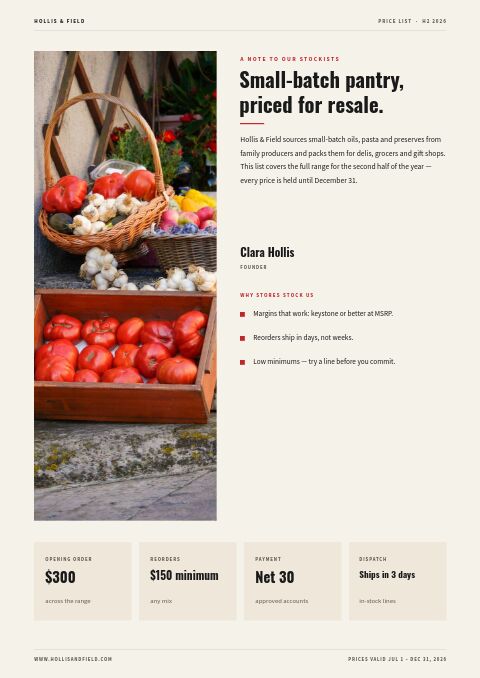
A cream-and-red price list for suppliers who publish trade prices by season. The cover doubles as an index, and every SKU inside carries its case pack, wholesale price and MSRP, set out for a fictional specialty food house.
Free plan available — all templates are included on every plan. Already have an account? Open it in Templates.
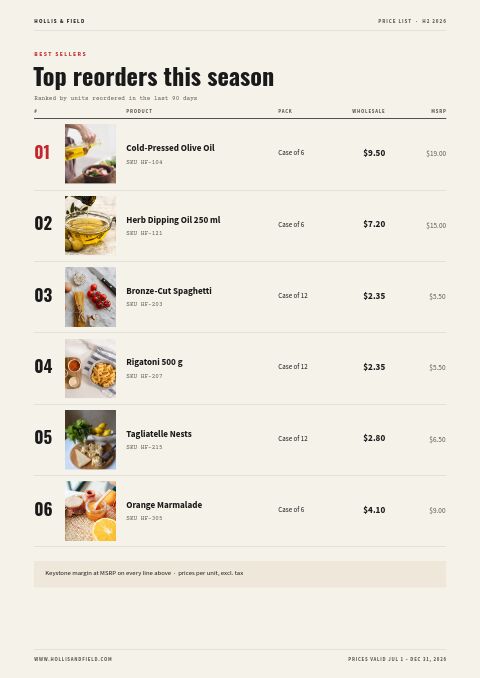

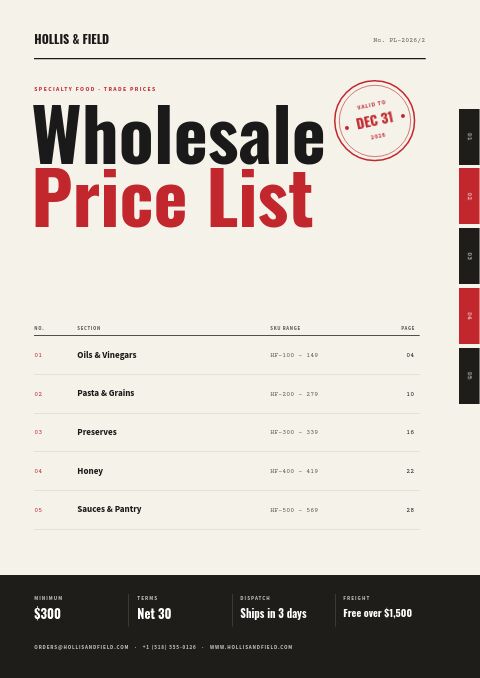
All 17 designed pages
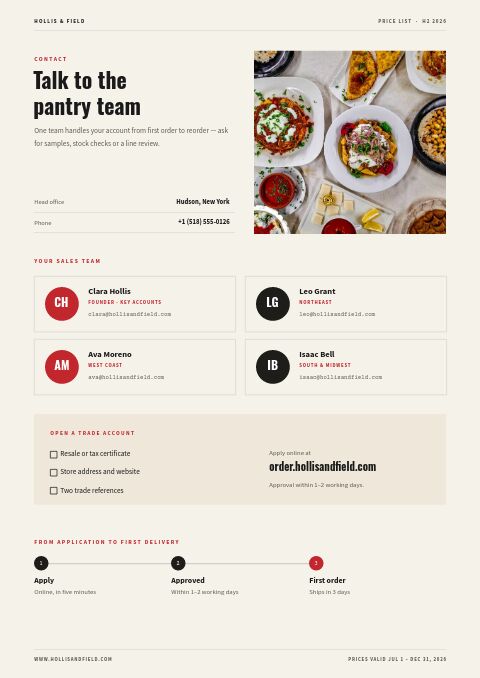
Covers, promotion and product-story pages built for this campaign. Use the ones you need; your product pages are added in the same style.
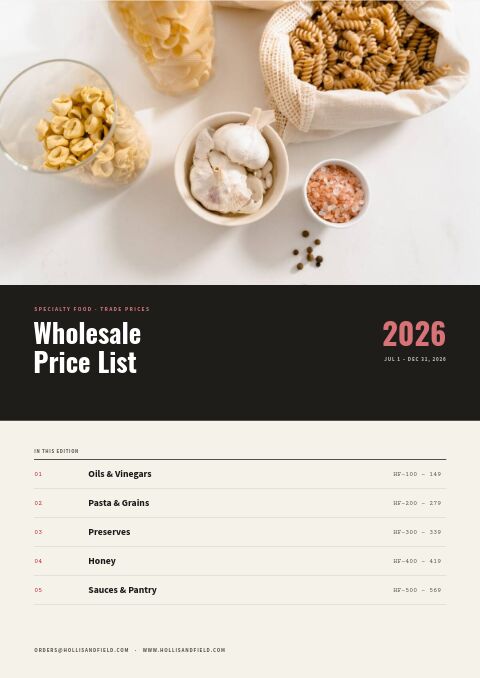
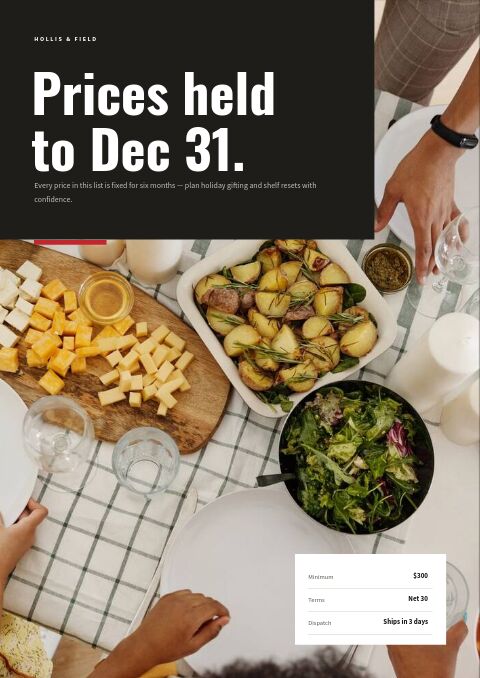




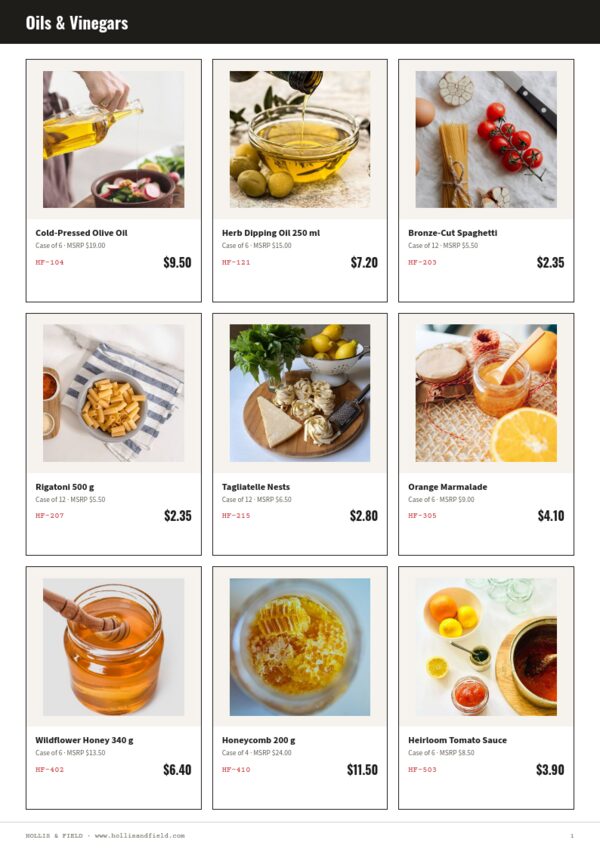
Product pages that fill themselves
Import your products and they take this layout automatically — shown here with sample products. Switch the grid any time, from 2 × 2 to 4 × 5 or a one-column line sheet.
About the Wholesale Price List template
Built like a dated trade document, this wholesale price sheet template uses tall Oswald headlines in black and signal red on warm cream, Courier Prime for document numbers and SKU ranges, and Source Sans Pro for the small print. On the cover, a round valid-to stamp sits beside the title, an index below lists each section with its SKU range and page number, numbered black and red tabs run down the edge, and a dark band carries minimum order, terms, dispatch and freight. Inner pages follow the same tidy grid.
Delis, grocers and gift shops keep a list like this on file for a half-year or a full year. Products imported from Shopify, a CSV or a product feed land on white grid pages with SKU, price and pack, and a Sync before each edition refreshes Shopify prices and stock. Send buyers a wholesale flipbook with an order form and volume tiers, or print a PDF to mail with samples. For the next season, update the stamp's date and the document number.
Best for
- Specialty food, pantry and gourmet producers selling to delis and grocers
- Suppliers who hold trade prices for six or twelve months
- Wholesalers sending a fresh price list with every season
- Brands with case-based price breaks and mixed-case rules
- Gift-shop suppliers taking holiday pre-books in late summer
Pages worth a closer look
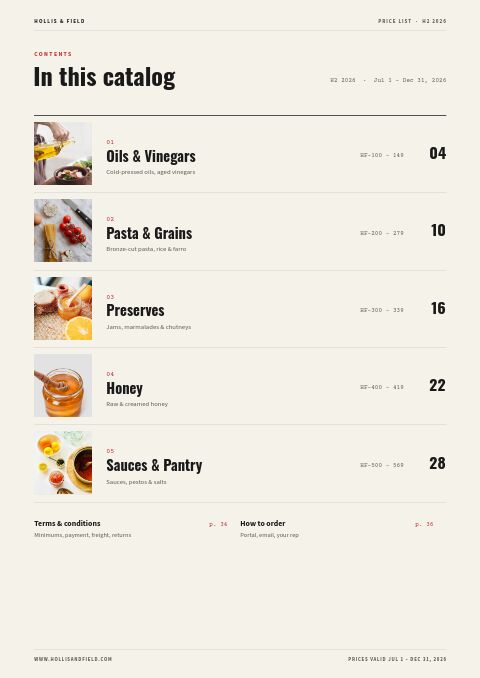
An index on the front cover
The cover lists every section with its number, SKU range and page, so the price list works like a directory. A round stamp shows how long prices are valid, and a footer band sums up minimum order, payment terms, dispatch and the free-freight threshold.
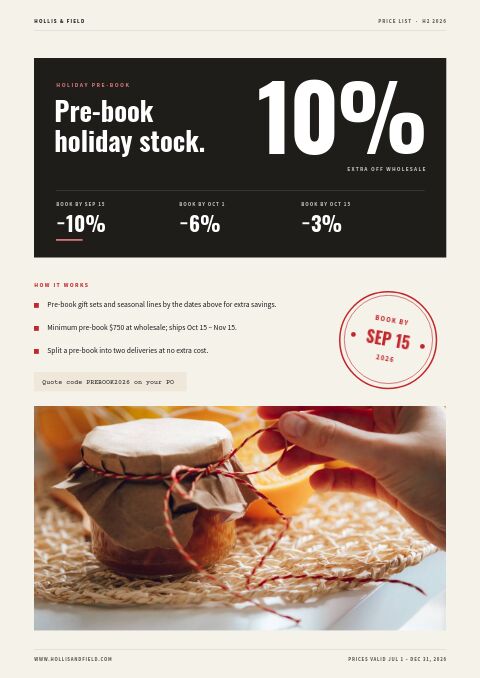
Holiday pre-book with a discount ladder
Buyers who book seasonal lines early earn a larger discount, shown as three dated steps with a pre-book minimum, a delivery window and the option to split delivery in two. Swap in your own dates for spring or holiday programs.
Figures food buyers weigh up
Six large numbers cover range size, average shelf life, markup at MSRP, number of producers, dispatch time and opening order. For food lines, shelf life and dispatch speed often decide whether a deli takes a chance on a new supplier.
Unit prices at one, five and ten cases
A clean table gives every SKU its case pack and its unit price at one case, five cases and ten cases, with a note on split and mixed cases. It is the page buyers return to whenever they reorder.
How to write a wholesale price list buyers can trust
Print a validity period
State the date each price list starts and ends, and give it a document number. Buyers plan shelf resets and holiday gifting months ahead, so a price held to a fixed date is worth highlighting. Say how much notice you give before prices change mid-term.
List unit and case prices together
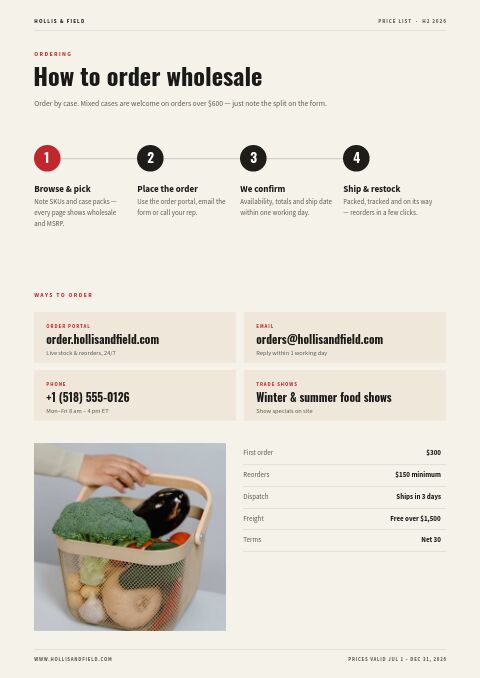
Stores compare costs per unit but order by the case. Show the case pack and unit price, or a unit price with case-based breaks, and the resulting case total. Note whether cases can be mixed and the order value above which mixed cases are accepted.
Add the details food buyers ask for
For food and drink, list net weight or volume, shelf life from dispatch, storage needs and the unit barcode. Ingredient and allergen notes save a round of emails, and origin details help a deli tell the product's story at the counter.
Keep SKU order consistent
Group products by section and keep SKUs in a predictable order that matches the order form. A buyer reordering from last season's list should find each line in the same place. Retire discontinued items in a short note rather than leaving gaps.
Make tasting easy
Delis and grocers rarely list a food line they have not tasted. Offer samples with an opening order or at trade shows, and print how to request them on the back cover. A modest sample budget often costs less than a sales visit.
From product list to finished catalog
Pick this template
Open Wholesale Price List in EasyCatalog and choose the cover and the pages you want — every page is optional and editable.
Add your products
Import from Shopify in one click, or upload a CSV, connect WooCommerce or a product feed. Your products fill the product pages automatically.
Download or share
Export a print-ready PDF (up to 300 DPI, CMYK and bleed for print shops) or share an online flipbook with a built-in order form.
Questions about this template
Can I use the Wholesale Price List template for products other than food?
Yes. The sample text is written for a specialty food supplier, but every heading, section name, color and photo can be changed. Rename the five sections, replace the featured product and stats, and import your own range; the indexed cover and price tables work for anything sold by the case.
How do I update the price list for a new season?
If your products come from Shopify, run Sync to refresh prices, stock and photos, then change the validity date and document number on the cover. With a CSV, upload the new file. Generate a fresh PDF or flipbook and send it to your accounts with a note on what changed.
What is the difference between a price list and a line sheet?
A line sheet presents each product with a photo, style number, prices and order details, and is common in fashion and gifts. A price list is more compact: rows of SKUs with pack sizes and prices, often with few photos. Many suppliers send both, or one catalog with product pages and a price table.
How much notice should suppliers give before raising wholesale prices?
Thirty to sixty days is common, and longer for retailers that print shelf labels or plan seasonal promotions. Announce the change with the new price list, give an effective date and honor orders placed before it. Holding prices to a fixed date, as this template's cover stamp does, removes much of the friction.


Start your Wholesale Price List
Pick this template, add your products and download a print-ready PDF or share an online flipbook. Free plan available, no card needed.