Musical instrument order form template in midnight and brass
Brass amber on midnight, framed like a stage: a seven-page set that gives instrument and studio gear suppliers a cover, contents, ordering terms and a printable order form for dealers.
Free plan available — all templates are included on every plan. Already have an account? Open it in Templates.


All 7 pages, in two versions
Cover, welcome letter, contents, how-to-order terms, a section divider, a wholesale order form and a back cover. Your product pages are added between them in the same fonts and colors.






About the Music & Instruments template
This musical instrument order form template belongs to a seven-page set with a stage-lit mood: cream and brass amber type on midnight pages, a thin brass frame around the layouts, and Abril Fatface display lettering with Oswald and Work Sans. The contents page is already divided into Guitars & Basses, Keys & Pianos, Drums & Percussion, Studio & Recording, and Accessories. Its photo-collage twin adds instrument photos to the cover, divider and back page, while the inner pages stay typographic.
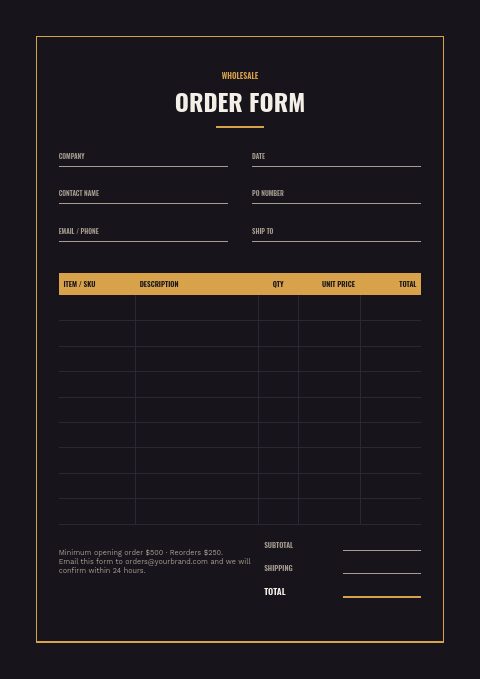
The order form gives music stores, school buyers and dealers room for company, PO number, ship-to, SKU, description, quantity and unit price, and the how-to-order page states your minimums, lead time and payment terms. Your instrument list can come from Shopify, WooCommerce or a CSV file; long runs of strings and accessories read well as one-column line-sheet rows, while guitars suit larger grids. Choose one of 12 palettes for a lighter print edition, then print it for dealer visits or share it as an ordering flipbook.
Best for
- Guitar and bass wholesalers selling to independent music shops
- Keyboard and piano suppliers taking dealer orders by email
- Drum and percussion brands that need a simple reorder sheet
- Studio and recording gear distributors starting their first catalog
- School music suppliers collecting orders from band directors
- Music shops printing a counter catalog with an order sheet
Pages worth a closer look
An order form inside the brass frame
The order page stays in character: a centered title over a short brass rule, ruled lines for the buyer's company and purchase order details, and an amber header across the item table. Totals sit at the foot beside a note with your minimums and order address, all inside the thin frame.
Contents for five instrument ranges
Guitars & Basses, Keys & Pianos, Drums & Percussion, Studio & Recording, and Accessories are listed in condensed capitals with page numbers, under a brass rule and inside the thin frame that runs through the set. Rename any range to match your lines.
A section divider with a large numeral
The divider opens a collection with a faint oversized number, the collection name in display serif and a short introduction. In the photo-collage version, two instrument photos sit above it, so a guitar section can open with guitars.
A framed cover in brass and cream
Music & Instruments is set in a high-contrast display serif, the first line in brass amber and the second in cream, inside a thin brass frame with a small diamond ornament. Your brand, edition year and contact line sit within the same frame.
How to build an order form for musical instruments
Separate instruments from consumables
Instruments are ordered one at a time, while consumables move in packs. Give strings, reeds, picks and sticks their own block on the form with a pack-size column, and print the pack beside each SKU, so a store's quantity means the same thing to both of you.
Name finish, handedness and size
Two guitars can share a model name and differ in finish, left- or right-handed build, or body size. Put those details in the description column or product title: sunburst, natural or black finish, left-handed, 3/4 size, or 61 versus 88 keys. A wrong-handed guitar is an expensive return for both sides.
Say what comes in the case
Buyers price an instrument differently when a hard case, gig bag, strap or tuner is included. List the contents with each model, and state whether guitars ship with a factory setup. For band instruments, name the mouthpiece, case type and care kit, because schools compare outfits line by line.
Print freight rules for bulky items
Drum kits, keyboards and amplifiers are heavy and oversized, and freight can erase the margin on a small order. State your free-freight threshold, any oversize charges and how damage claims work for large boxes. Clear freight terms help a store decide whether to combine a reorder or wait a week.
From product list to finished catalog
Start with this set
Open Music & Instruments in EasyCatalog, in the clean or the photo version, and recolor it with one of 12 palettes if you like.
Add your products
Import from Shopify in one click, or upload a CSV, connect WooCommerce or a product feed. Your products fill the product pages automatically.
Download or share
Export a print-ready PDF (up to 300 DPI, CMYK and bleed for print shops) or share an online flipbook with a built-in order form.
Questions about this template
Does the order form come with matching catalog pages?
Yes. Around the order form sit a cover, a welcome letter, a contents page for five instrument ranges, ordering terms, a section divider and a back page, all in the same midnight and brass style. Your products fill grid pages from the editor, which you can style to match, and every word can be edited.
Can I lighten the dark design for office printing?
Yes. Dark full-page backgrounds use a lot of ink on office printers, so switch to one of the 12 palettes for a light print-at-home edition and keep midnight for the flipbook. For a commercial run, export with the CMYK Print professional option and a 3 mm or 5 mm bleed with crop marks.
What should each product listing in a music catalog show?
Show a front photo, model name, SKU, finish, size or key count, body and top materials, and what is included, such as a case or gig bag. Add the dealer price with suggested retail or MAP, and a barcode if stores receive by scanning. Short spec lines help staff answer customers on the shop floor.
How do music wholesalers usually pack strings and accessories?
Strings usually sell in cases of 10 or 12 sets per gauge, picks in bags or display jars, and drumsticks in pairs or bricks of 12 pairs. Reeds come in boxes sorted by strength. Print the pack size beside each item and let the order form take quantities in those units, so stores never order half a case.




Start your Music & Instruments catalog
Pick this template, add your products and download a print-ready PDF or share an online flipbook. Free plan available, no card needed.